
HOW TO SPOT A FAKE ROLEX: THE COMPLETE GUIDE FROM BONHILL
Rolex watches represent a perfect fusion of luxury, prestige, and timeless elegance, providing immense pleasure to their owners. Rolex’s worldwide allure has established a benchmark for quality and sophistication in the watchmaking realm.
However, this popularity has also given rise to a murky market filled with remarkably convincing counterfeit watches, capable of fooling even the most experienced enthusiasts.
Our comprehensive guide is designed to equip you with the insights needed to identify authentic Rolex models—such as the Submariner, GMT Master II, Datejust, Daytona, Sea-Dweller, Lady-Datejust, Sky Dweller…—from imitations, ensuring that your purchase truly reflects your passion for these remarkable timepieces.
TRUST YOUR SELLER
Before we get into the details of exactly how to spot a fake Rolex, the most prominent defense against accidentally purchasing a counterfeit watch is to know and trust the person selling it to you, whether that person is a particular or a professional.
KNOW THE MODEL YOU ARE LOOKING AT
To effectively identify a counterfeit Rolex, it’s crucial to familiarize yourself with the specific model’s genuine appearance. Recognizing the reference number will guide you in knowing how the watch should appear. For instance, the Sea-Dweller ref. 126600 is expected to have a cyclops, while other Sea-Dweller models do not. Generally, if a Rolex listing lacks a proper model number, it should raise suspicion.
LOOK AT THE SERIAL OF THE ROLEX WATCH
The serial number has traditionally been located at 6 o’clock between the lugs and under the bracelet. In 2005, Rolex began engraving the serial number on the rehaut (French for ‘flange’) between the dial and the crystal as well as the 6′ o’clock location.
For a few years, Rolexes had two serial numbers engraved on them. Starting in 2008, Rolex stopped engraving the serial # at the case 6 o’clock location, using only the rehaut location. By 2010 this practice had gradually transitioned to all models.
Watches made before 2007 will have the serial number engraved on the case between the bottom lugs. The lugs are where the band connects to the case. In order to find this serial number, you’ll have to remove the band of your watch.
For some models between 2006 and 2007, you’ll find the serial number engraved on the dial rehaut (inside metal ring). This is the inner bezel, and you’ll find it around 6 o’clock. Some models during this time will also have it engraved on the case between the bottom lugs as well.
You’ll have to look carefully for the serial number on the dial rehaut. Looking carefully at the 6 o’clock position, you should be able to see it through the crystal.
Watches made after 2008 gradually lost the engraving between the bottom lugs as this was easier to replicate. You’ll only find it on the inner rehaut. If you have the paperwork for your watch, you’ll find the serial number there as well.
It’s a good idea to match the engraving on the watch to the one on the paperwork when you’re buying the watch.
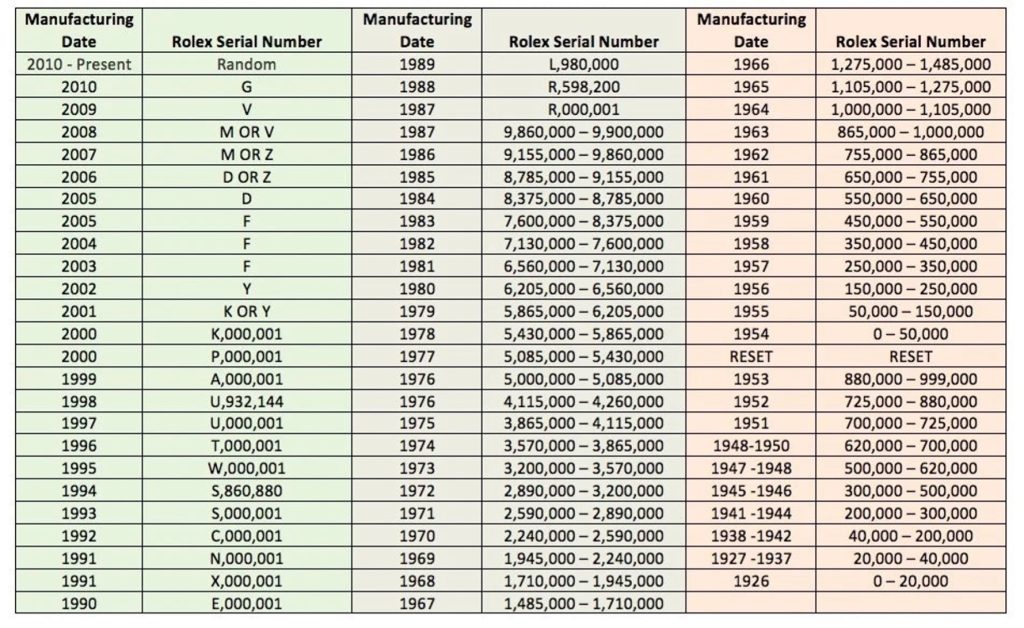
Also, in 2009, Rolex started to discontinue their conventional numbering sequence in favor for a mixed (aka random aka scrambled) serial. They will be 8 digits, opposed to 7 in the past.
So until 2010, there was a system that is delineated in the table below. Between 1926 and 1987 Rolex used sequential serial numbers that are easy to look up. Between mid-1987 and late 2009, they used a simple date code to help with the date of production. A letter at the beginning of the number would tell you what year, instantly.
Fake watches often re-use the same (or partially the same) serial numbers. Beware if a watch’s serial ends in L6V6, U9N5 or Y2L3. If it starts with ER6J, K28, K25, Q66, S19, S28, S29 or S39 your eyebrows should also be raised.
There are many websites where you can enter a specific Rolex serial number and it tells you the year of manufacture, so you have to check that that model could really have been manufactured in that year.
For example, if a watch has a serial number produced in the year 1990, but that model could not have been manufactured in that year since it did not exist, you already know that something is wrong with that watch.
LOOK AT THE ROLEX MOVEMENT
At the core of every genuine Rolex watch is a movement that exemplifies exceptional craftsmanship, designed with an unwavering focus on precision.
The intricate assembly of gears and springs within an authentic Rolex guarantees that each timepiece is marked with the Rolex engraving as a hallmark of authenticity.
This meticulous attention to detail in both appearance and functionality is only revealed when the case is opened, showcasing the flawless workmanship expected from such a distinguished brand.
It’s essential to remember that Rolex’s identity as a watchmaker is largely mechanical. If you come across a Rolex featuring a quartz movement, it should raise immediate red flags.
Throughout its storied history, Rolex has produced only a few quartz models, making them rare exceptions.
With the rise of advanced counterfeiting methods like optical scanning and 3D printing, counterfeiters can create ‘super fakes’ that closely mimic genuine Rolex movements.
While these imitations may appear convincing at first glance, a careful examination will reveal their shortcomings.
The cloned movements lack the exquisite finishing and reliable accuracy that Rolex is famous for—qualities that elevate a Rolex beyond mere timekeeping.

ROLEX CYCLOPS : REAL VS FAKE
Rolex’s cyclops lens offers a unique 2.5x magnification, making the date appear prominently within the window. If there’s no magnification, it’s often a sign of a counterfeit. The date numbers should be perfectly centered in the white box; in contrast, fake versions frequently display misaligned dates.

ROLEX ENGRAVINGS : REAL VS FAKE
Determining whether a Rolex is genuine often hinges on the careful analysis of its serial and case reference numbers.
Authentic Rolex watches showcase their identity through precisely engraved serial and model numbers, which are so finely executed that they sparkle and catch the light, much like a beautifully cut diamond.
In contrast, counterfeit watches typically reveal their flaws in this area. Their numbers may appear dotted or smudged due to inferior engraving methods, resulting in a rough, acid-etched look that can be identified in our comparison images.
Moreover, counterfeiters often lack the originality found in genuine Rolex timepieces; they may use the same serial and reference numbers across different models, a shortcut that authentic Rolex craftsmanship avoids.
Every Rolex watch is equipped with its own unique identifiers, and the reference numbers convey important details about its design and history.

ROLEX LASER-ETCHED CRYSTAL (LEC)
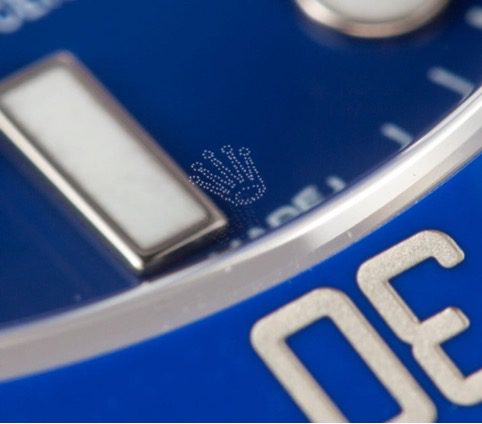
In 2002, the brand began incorporating a tiny crown logo etched into the crystal above the dial, positioned precisely at the 6 o’clock mark.
This micro-etching exemplifies Rolex’s commitment to craftsmanship and acts as a hallmark of authenticity for watches made from that year onward. Its small size makes it difficult to see without a magnifying glass and the right lighting, but it’s a detail that discerning collectors should seek out as evidence of a genuine piece.
This delicate engraving is Rolex’s method of embedding security directly into their timepieces. The complexity involved in creating and positioning this micro-logo makes it incredibly challenging for counterfeiters to replicate effectively.
It’s on every modern sport Rolex except the Milgauss GV with the green crystal.
WEIGHT
Rolex watches are crafted from premium materials, and their contemporary bracelets tend to have a substantial weight.
While some counterfeit versions are noticeably lighter, weight alone isn’t a definitive indicator of authenticity.
Vintage Rolex models are significantly lighter than their modern counterparts, leading some owners to mistakenly assume that older models are fake due to their reduced weight.
However, it’s important to note that imitation gold watches are never made from solid gold, so they will not have the same heft as a genuine gold Rolex.
It is important to know the weight of the original model, and compare it with the watch you want to know if it is a fake.
ABOUT BONHILL GROUP
Bonhill’s jewelry passion arises from 1916 when a jewelry maker family started creating silver masterpieces with the ambition of becoming the provider of the most exclusive and luxurious brands. A dream that came true due to their enthusiasm, compromise and expertise.
After 100 years of history the legacy continues with a new approach.
Today Bonhill masters the art of jewelry appraisal around the world leaded by the same values; excellence, commitment, trust, expertise and innovation.
Bonhill offer to our customers a unique and pleasant selling experience based on trust, through an innovative purchasing process where we always guarantee an exquisite and exclusive treatment and the highest price of the market. You will be able to sell rolex or sell watches, jewel or diamond to Bonhill in a unique way.
Our mission is to offer our customers a unique and pleasant sales experience, based on trust, through an innovative purchasing process where we always guarantee an exquisite and exclusive treatment and the highest price in the market.
You can sell your watch, jewel or diamond to Bonhill in a unique way and at the best price.